YC2513L UV Flatbed Printer
Full specifications and machine images.

A 2.5 x 1.3 m platform aimed at shops moving from screen printing to direct digital production.
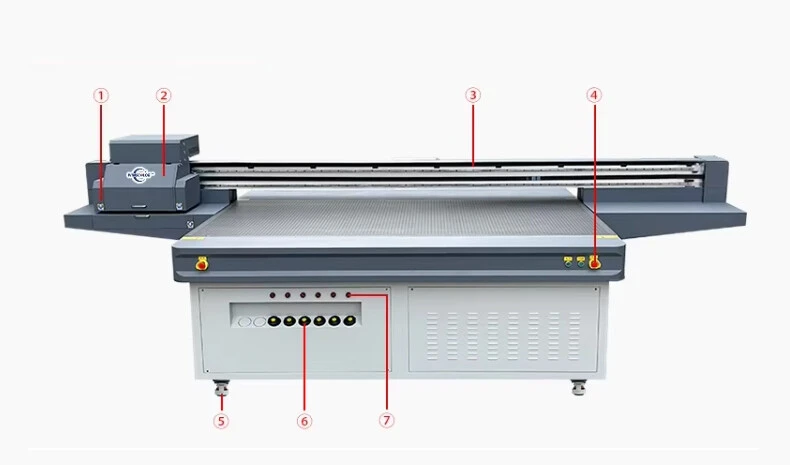
The 2513L is a 2.5 x 1.3 m UV flatbed printer with Ricoh heads, variable drops and UV-LED curing. It prints rigid sheets up to 400 mm thick.
Winscolor aims it at shops moving from screen printing to direct digital work.
Production speed is rated up to 25 square metres per hour.
Most signage and decoration work starts from a 2.44 by 1.22 metre board, the standard sheet size in the trade, and it is the size most suppliers keep in stock. A 2.5 by 1.3 metre table accepts that sheet with a margin on every side, so the operator does not need to trim material before printing or worry about the sheet drifting while it is loaded.
That margin matters more than it looks. A sheet that overhangs the vacuum table loses suction at the edge, and the gap between the head and the substrate changes as the material lifts. On a table sized exactly to the board, operators often mask the unused area to keep the vacuum strong. A slightly larger table removes that step and lets a half sheet be printed without masking the rest.
The same platform also takes smaller sheets for short runs. A shop can print one phone shell in the morning and a full display panel in the afternoon on the same machine, which is difficult with screen printing because each job requires a screen, a setup and a cleaning cycle.
For a shop that already cuts 2.44 by 1.22 metre sheets, the table size also decides how much material is wasted at the edge. A table that is slightly larger than the sheet leaves room for positioning and for the vacuum to hold the full area, which matters on thin or warped boards where an unsupported corner lifts under the printhead and ruins the pass.
The 2513L accepts two to eight Ricoh GEN5 or GEN6 printheads. The number is chosen at order time and determines both throughput and the colour channels that can run at full speed.
A two-head machine is a low-cost entry point for shops that print mostly CMYK work at moderate volume. Four heads are the usual choice for signage production, because they double the colour throughput and keep print quality stable over long shifts. Six or eight heads are ordered by shops that run white and varnish every day: with more heads, those channels have their own nozzles and do not force the colour pass to slow down.
The printheads are industrial Ricoh units with stainless steel internal heating, designed for continuous operation rather than occasional use. The machine is rated for long working days, which is why it is usually installed in a production area rather than a design studio.
Transparent acrylic, glass and dark metals need a white underlay before colour. If white is printed through the same nozzles as cyan, magenta and yellow, the machine has to stop, flush and switch inks, which wastes time and material. The 2513L keeps white and varnish on separate channels so all channels can print in one pass.
Varnish adds gloss and surface protection. On acrylic light boxes and decorative panels it also deepens the colour, because the clear layer changes how light reflects from the printed surface. On shop fittings and signage that will be cleaned often, the varnish layer reduces wear on the ink.
The variable drop system covers 6 to 42 picolitres. Small drops are used for fine text, gradients and photographic panels; larger drops lay down solid colour and white underlay faster. The controller selects the drop size according to the file and the print mode, so the operator does not have to swap settings for every job.
The published production speed is up to 25 square metres per hour. That figure depends on resolution, drop size and the amount of white and varnish in the job, so a shop should plan capacity around its own mix of work rather than the headline number. A job that is mostly solid colour with white underlay runs slower than a CMYK poster.
Maintenance is mostly daily nozzle checks, a weekly clean of the capping station and periodic replacement of consumables. The vacuum table and the linear guides need to be kept free of dust and ink mist, because dust on the guide rail shows up as banding long before it causes a mechanical fault.
Floor space is the constraint that surprises new buyers. The machine itself measures 4400 by 2100 by 1400 mm, but the carriage travel and the loading area add to that footprint. Leave room at both ends of the table and enough clearance in front for a full sheet to be lifted into place.
Power is 380 V three-phase for the larger flatbeds. The exact current rating is confirmed in the quotation for the chosen configuration, because it changes with the number of UV lamps and printheads.
The 2513L suits a shop that already sells signage, decoration or industrial panels and wants to bring printing in house. The work is mostly rigid, the sheet sizes are known, and the volumes are high enough that a flatbed pays for itself against screen printing or outsourcing. It also suits a screen printer adding short-run and one-off work, because the digital machine removes the screen setup that makes small jobs unprofitable.
It is a poor fit for a shop that prints only flexible banner material. A roll-to-roll machine feeds that media from a roll and runs continuously; a flatbed has to load one sheet at a time. Combined roll-to-roll flatbeds exist for shops that do both, and Winscolor lists them as a separate family.
It is also a poor fit for a business without the floor space or the power supply. The machine needs three-phase power, a flat floor and room for loading full sheets. If those conditions are not met, a smaller model such as the YC1610H or YC6090 is a better starting point, and the shop can move up when the volume justifies it.
Before the machine arrives, confirm the power supply, the floor and the access route. The 2513L is delivered in a wooden case and has to pass through the door and into the production area without being tipped. Measure the narrowest opening on the route before the shipping date, not after the case is on the truck.
The floor should be level and able to carry the machine plus the material stack. A flat floor matters because the vacuum table and the head height are calibrated on site; an uneven floor makes that calibration harder and can show up later as inconsistent head clearance across the table.
Prepare a stable environment. UV printers work best away from direct sunlight, dust and strong air movement. Dust settles on the table and the guides, and ink mist from the printing process needs to be extracted or filtered. A room that is clean and temperature-stable will produce more consistent output than one that is not, regardless of the machine.
Finally, plan the workflow around the machine rather than around the old process. Loading, printing and unloading overlap poorly on a flatbed, so a shop that runs long jobs needs enough space to stage the next sheet while the current one prints. The machine is fast; the material handling around it is usually what limits daily output.
| 7 picolitres | Fine text, gradients and photographic detail |
|---|---|
| 14 picolitres | General signage and display work |
| 21 picolitres | Solid colour and white underlay |
| 1440 dpi | Maximum resolution with Ricoh heads |
Full specifications and machine images.
The flatbed range from 600 x 900 mm to 3.3 x 2.1 m.