YC3321R
Alternative size and head configuration.

A 2.5 x 1.3 m flatbed with a 2.5 m roll feed for banners and flexible media.
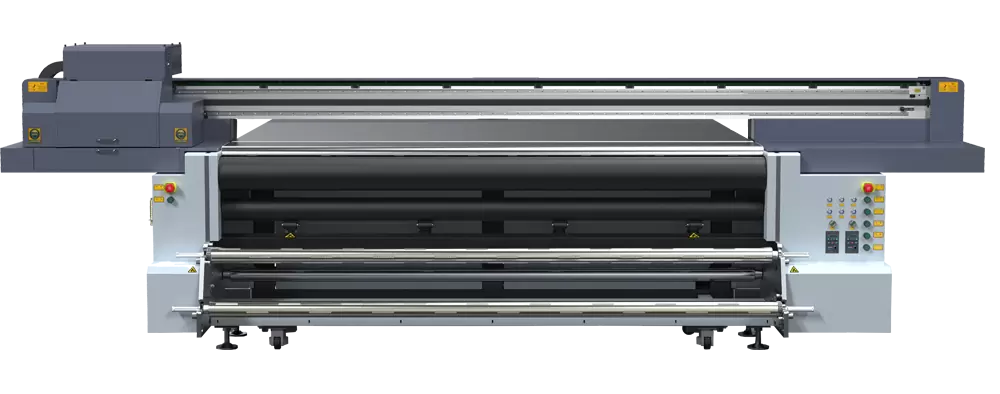
2.5 m roll feed
Ricoh heads
8-33 sqm/h
| Product model | YC2513R model |
|---|---|
| Printhead type | RICOH GEN5 / GEN6 / KM1024I / SPT1024GS models |
| Printhead number | 2 to 8 heads |
| Printing size | 2500 x 1300 mm |
| Roller material width | 2500 mm |
| Media thickness | 0 to 100 mm |
| Print resolution | 720 x 600 to 720 x 1200 dpi |
| Print speed | 8 to 33 sqm/h |
| Ink reservoirs | 2500 ml per colour |
| Power supply | 220 V, 8500 W |
| Machine weight | 2000 kg |
A short video of the YC2513R printing the material this shop uses most. Keep it under two minutes and show the loading, printing and finished sheet.
To supply: marketing/video · design: video block with poster image





The YC2513R keeps the vacuum table and adds a media feed, so the same frame prints the stated rigid sheets and flexible rolls. That combination matters for shops that take both signage and banner work: one machine, one operator, one maintenance routine.
Roll media is loaded on a shaft, fed across the table and taken up at the far end. The vacuum holds the material flat while it passes under the carriage, which keeps the head height constant on thin film and banner cloth. Rigid sheets use the same table with the feed disengaged.
Ink choice follows the media. UV-curable ink works on both rigid and flexible substrates, with white and varnish as separate channels for transparent or dark material. Media thickness on the rigid side runs to 100 mm; flexible media follows the same head clearance, so very thick banner material should be checked with sales before ordering.
Print speed depends on the pass mode. Draft settings run faster at lower resolution, production settings slower at higher resolution. The published range of 8 to 33 square metres per hour covers both ends; GEN6 heads run roughly 40 percent faster than the GEN5 figure at the same pass mode.
Because the machine does both jobs, changeover is the skill to learn. Switching from a roll to a rigid sheet means stopping the feed, cleaning the table and resetting the head height. Shops that batch work by media type get more out of the machine than shops that switch every job.
Maintenance covers both paths: the roller and take-up need checking for tension and edge drift, and the table and rails need the same cleaning as a flatbed. A weekly inspection of the feed path prevents the most common failure, which is media wandering and printing off-register.
Colour on flexible media drifts with the material batch. Banner and backlit film absorb ink differently, and a profile that suited last month roll can print slightly warm on the next. Keeping a test strip at the start of each roll is a cheap way to catch the drift before a long run.
Rigid work on the same machine benefits from the feed experience: the operator already knows how the material behaves under the heads, and the same colour library applies to both paths. That shared knowledge is the practical advantage of a combined machine over two separate printers.
Tell us the head count, ink channels and voltage you need.
Contact sales