YC2513R
Alternative size and head configuration.

A 3.2 m hybrid flatbed with roll feed for packaging, display and industrial panels.
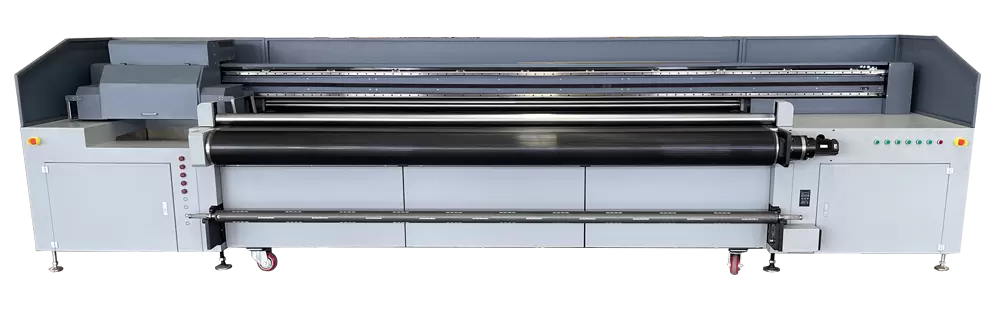
3.2 m print width
Roll and flatbed
8-33 sqm/h
| Product model | YC3200HR model |
|---|---|
| Printhead type | RICOH GEN5 / GEN6 / KM1024I / SPT1024GS models |
| Printhead number | 2 to 8 units |
| Printing width | 3200 mm |
| Media thickness | 0 to 100 mm |
| Print resolution | 720 x 600 to 720 x 1200 dpi |
| Print speed | 8 to 33 sqm/h |
| Media weight | 80 kg max |
| Power supply | 220 V, 8500 W |
| Machine weight | 3000 kg |
A short video of the YC3200HR printing the material this shop uses most. Keep it under two minutes and show the loading, printing and finished sheet.
To supply: marketing/video · design: video block with poster image




The YC3200HR is a wide hybrid: a 3.2 metre flatbed with a roll feed. It is aimed at shops producing packaging board, display panels and industrial sheets, where the job mix changes between rigid and flexible material during the week.
The table is anodised aluminium with four vacuum sections. Anodised aluminium resists ink mist and cleaning chemicals better than a painted surface, and the four sections let the operator hold a narrow sheet without pulling vacuum across the full width.
The printhead set is Ricoh GEN5 or GEN6, with KM1024I and SPT1024GS also listed as options. Two to eight heads are fitted. Head count is the main lever on throughput and on how many channels can run at full speed: white and varnish need their own heads to avoid stopping the colour pass.
Media handling is automatic at the reel, with release and take-up. On long runs the operator can leave the machine to print a full roll and return for the next job, which is difficult on a flatbed-only machine where every sheet needs loading.
Substrates include wallpaper, flex banner, glass, acrylic, wood board, ceramic, metal plate, PVC board and corrugated board. The common failure on wide machines is edge curl on thin material; the vacuum and the feed tension have to be balanced so the sheet stays flat without stretching.
Speed settings follow resolution. The 8 to 33 square metre per hour range covers draft through production modes, and the same rule applies as on any UV printer: the lamp output, the ink laydown and the carriage speed must be matched, or the print looks fine and fails a scratch test later.
Production planning on a wide machine is about batching. Jobs of the same media and thickness run back to back; switching material means resetting the feed and checking the head height. Shops that plan the week by material type run more square metres per shift than shops that change material for every order.
Packaging board also needs attention at the edges. Cut edges absorb ink differently from the liner surface, and a job that looks even on the flat can show a darker rim where the board was guillotined. Trimming after printing, or allowing for the edge in the layout, solves most of it.
Tell us the head count, ink channels and voltage you need.
Contact sales